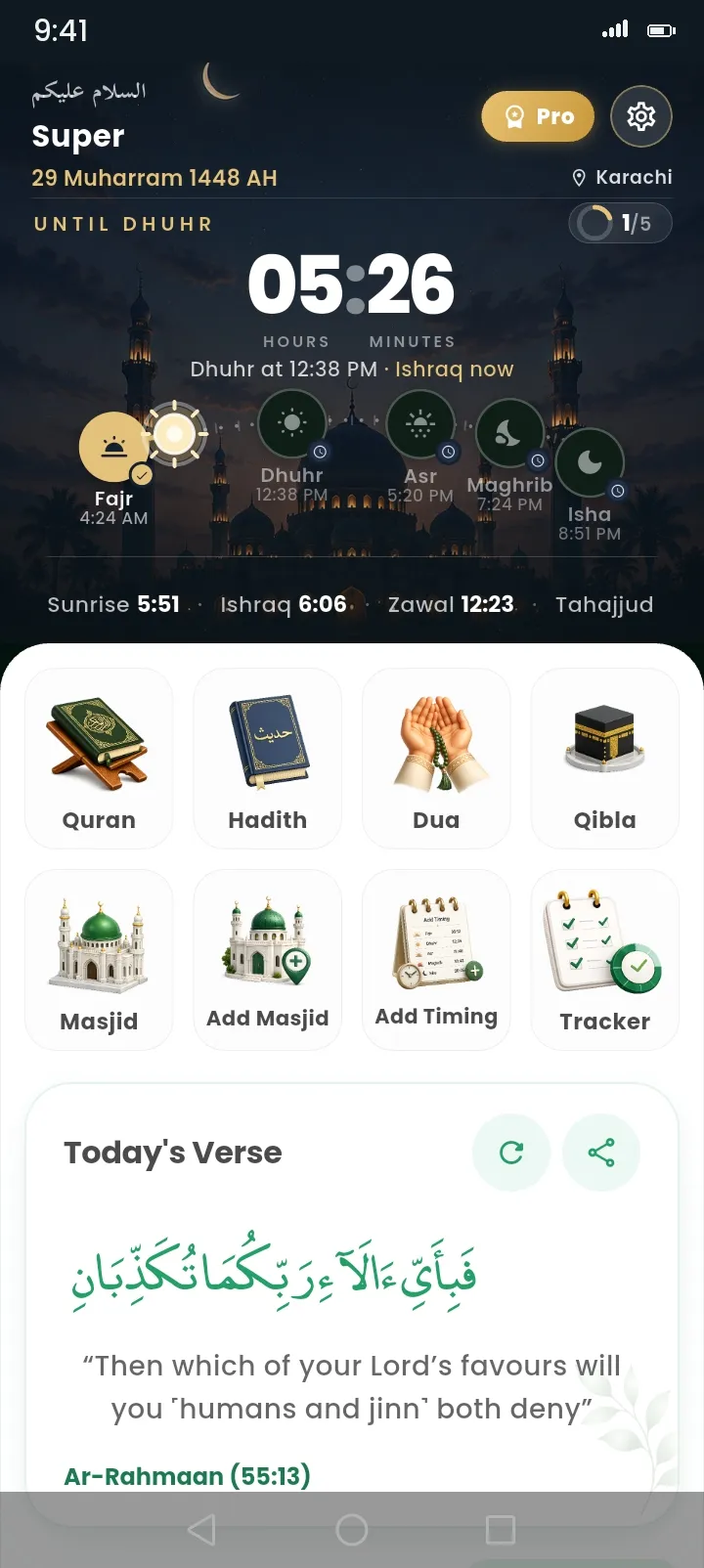
What actually determines each prayer’s window
Every prayer time — whether you call it salah time or namaz time — is an astronomical event, defined by where the sun is relative to your horizon:
- Fajr begins at true dawn, when the sun is still a set angle below the eastern horizon and the first light spreads across the sky.
- Dhuhr begins just after the sun passes its zenith — its highest point of the day.
- Asr begins when an object’s shadow reaches a defined multiple of its length.
- Maghrib begins at sunset, when the sun’s disc drops below the horizon.
- Isha begins at nightfall, when the sun is far enough below the western horizon that twilight has faded.
Because these are positions of the sun, prayer times depend on where you are standing. Al-Noor Islam computes them from your precise GPS location — or from any city you choose — and you can see the result for your area on the live prayer times page.
Why apps disagree: the calculation methods
Sunset and solar noon are unambiguous, so Maghrib and Dhuhr rarely differ between apps. The disagreement is almost always about Fajr and Isha: “true dawn” and “nightfall” are defined by how many degrees the sun sits below the horizon, and different institutions have adopted slightly different angles from their own observations. Each set of angles is a calculation method.
Al-Noor Islam supports 23 calculation methods, including all the major ones:
- Muslim World League (MWL) — widely used across Europe and much of the world.
- ISNA — the standard for most of North America.
- Umm al-Qura — used in Makkah and Saudi Arabia.
- University of Karachi — standard in Pakistan and common across South Asia.
- Egyptian General Authority — Egypt and parts of Africa and the Middle East.
- Diyanet — Turkey’s religious authority.
- JAKIM, Kemenag and MUIS — the official bodies of Malaysia, Indonesia and Singapore.
- Moonsighting Committee Worldwide — favoured by many communities at higher latitudes.
- Plus regional methods for Dubai, Kuwait, Qatar, Tehran, France (UOIF), Russia, Morocco, Tunisia, Algeria, Jordan and more.
None of these is “wrong”. They are careful institutional answers to the same question, tuned to local skies and local practice. What matters is using the method your community follows — which is why two apps set to different methods can both be accurate and still show different Fajr and Isha times.
Hanafi vs Standard Asr
One more setting changes a time noticeably: the Asr school. Asr is defined by shadow length, and the two juristic positions measure it differently:
- Standard (Shafi’i, Maliki, Hanbali). Asr begins when an object’s shadow equals its own length — one shadow length.
- Hanafi. Asr begins when the shadow reaches twice the object’s length, so Hanafi Asr time always falls later in the afternoon.
If your Asr never matches a friend’s, this is usually the reason — not the calculation method. Al-Noor Islam lets you switch between the two schools with a single setting; follow whichever your madhhab or local masjid uses.
Set it up once, then trust it
The point of understanding all this is that you only need to make the choice once. In Al-Noor Islam:
- The right method is picked for you. The app auto-selects a calculation method based on your location — and if your community follows a different one, you can override it. Your choice is remembered.
- Fine-tune per prayer. Manual offsets let you nudge any individual prayer by a few minutes to match a local timetable exactly.
- Adhan alarms, your way. Set a per-prayer alarm with a choice of adhan sounds — Adhan, Adhan Madinah, Takbir or Gentle Adhan — or use your own audio, and pick a quiet reminder or a full alarm for each prayer.
- Always in context. The live Hijri date is shown alongside your times, and everything recomputes automatically as you travel or as the seasons shift.
And since you are lining up your day around the sun anyway, the qibla compass guide covers the other direction question: which way to face.
Calculated times vs your masjid’s jama’ah
One last distinction. Everything above answers “when does the prayer window open?” Your masjid answers a different question — “when do we pray together?” — by fixing its own jama’ah time inside that window. That is why the calculated time on your phone rarely matches the moment your imam says the takbir. Both are correct; see the jama’ah & iqamah times guide for how the two fit together.
Frequently asked questions
- Why do prayer time apps show different times?
- Almost always because they use different calculation methods. Fajr and Isha are tied to how far the sun sits below the horizon, and institutions define that angle differently, so two correct apps can disagree by several minutes. Setting both apps to the same method — and the same Asr school — usually makes the times match.
- Which calculation method should I use in the USA, UK or Pakistan?
- In North America, ISNA is the most widely followed method; in Pakistan, the University of Karachi method is standard; in the UK and at high latitudes generally, many communities follow the Muslim World League or the Moonsighting Committee Worldwide. The most reliable answer is to match your local masjid — Al-Noor Islam auto-selects a sensible method from your location, and you can override it at any time.
- Why is my Asr time different from my friend’s?
- You are probably following different Asr schools. The Hanafi school begins Asr when an object’s shadow reaches twice its length, while the Standard (Shafi’i) position uses one shadow length — so Hanafi Asr always starts later in the day. Both are valid juristic positions; pick the one your school or masjid follows.
- Do prayer times change every day?
- Yes, slightly. Prayer times follow the sun, and the sun’s path shifts a little each day with the seasons — Fajr and Isha move the most, Dhuhr the least. That is why apps recalculate daily from your exact coordinates instead of using a fixed timetable.
- Are calculated prayer times the same as my masjid’s congregation times?
- No. A calculated time marks the moment a prayer’s window opens; your masjid then fixes a jama’ah time inside that window so the community can gather. Al-Noor Islam shows both — the calculated times for your location and each masjid’s own jama’ah schedule.
Keep reading
- Find a mosque near youFind nearby mosques on a live map, compare jama’ah times, and check facilities like parking and wudu before you leave — here is how.
- Jama’ah & iqamah timesAdhan, iqamah and jama’ah are three different moments. What each means, why masjid congregation times differ from calculated prayer times, and how to arrive on time.
- Ramadan 2027Ramadan 2027 is expected to begin on Monday 8 February and Eid al-Fitr to fall on Tuesday 9 March. Key dates, the last ten nights, and sehri and iftar times.